- Form
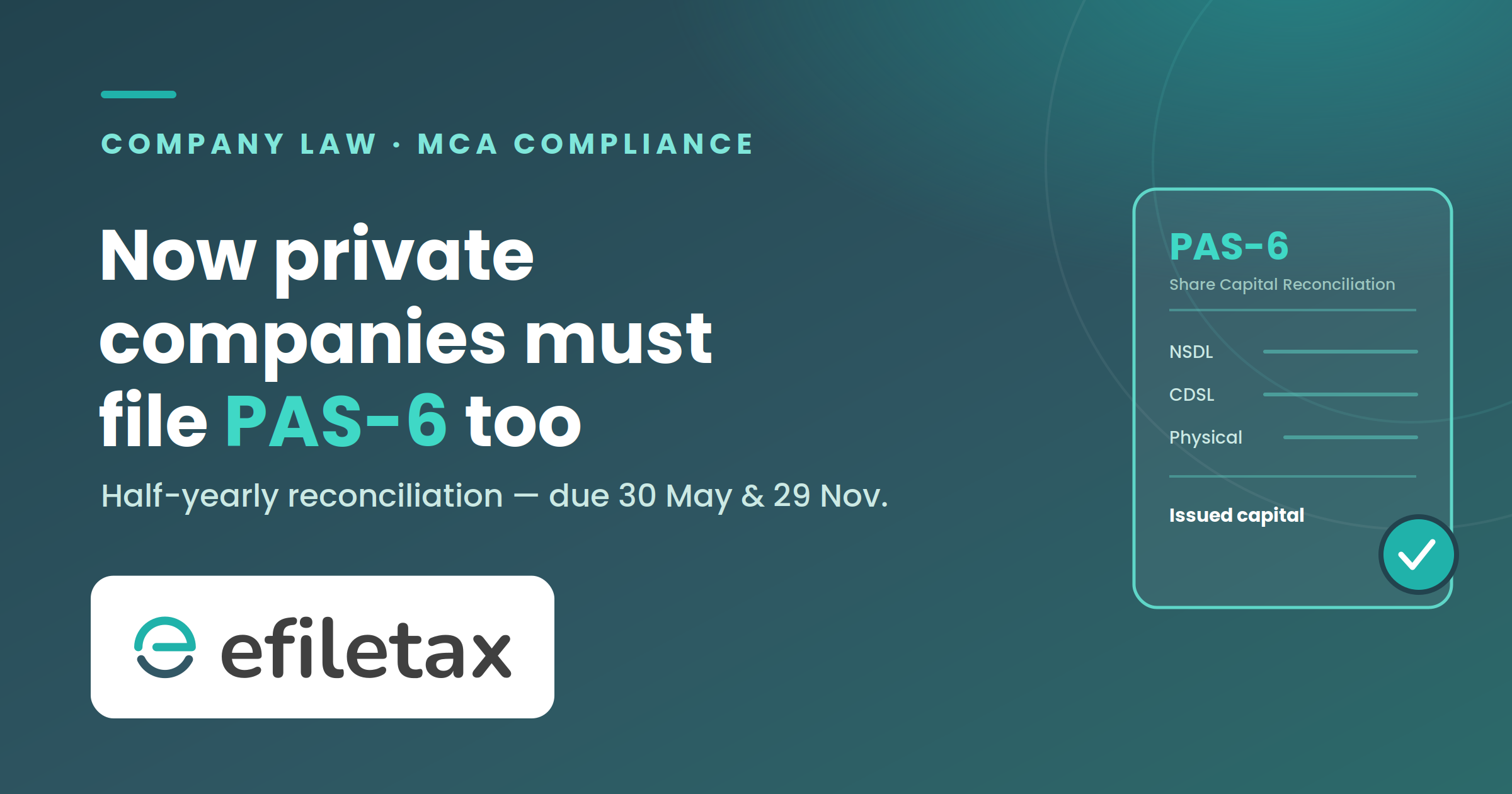
- PAS-6 — Share Capital Reconciliation
- Who files
- Unlisted public + non-small private
- Frequency
- Half-yearly (within 60 days)
- Due dates
- 30 May & 29 November
The short version
- PAS-6 is the half-yearly Reconciliation of Share Capital Audit Report — it reconciles a company's issued capital with what's held in demat (NSDL/CDSL) and physical form.
- It's no longer just a public-company form. Since the Rule 9B demat mandate, non-small private companies must file it too — their first PAS-6 was for the half-year ended September 2025 (due 29 November 2025).
- Due 30 May (Oct-Mar half) and 29 November (Apr-Sep half), every applicable half-year — even with no change in shareholding — certified by a practising CS/CA with UDIN.
- From 1 December 2025, the "small company" limits rose to ₹10 crore / ₹100 crore — but holding, subsidiary and Section 8 companies are never "small," so check your status carefully.
For years, PAS-6 was something only public companies worried about. That changed with the push to dematerialise private-company shares — and a large slice of private companies are now in the net, many without realising it. Here's what the form is, who has to file it, and how to get it right.
What PAS-6 actually is
PAS-6 is a Reconciliation of Share Capital Audit Report, filed with the Registrar of Companies under Rule 9A(8) of the Companies (Prospectus and Allotment of Securities) Rules, 2014. Every half-year, the company reconciles its issued capital against how those shares are actually held — dematerialised with NSDL, dematerialised with CDSL, or still in physical form — and explains any difference. It also captures changes in capital during the half-year, the status of the register of members, and any demat requests pending beyond 21 days.
Who must file
Two groups are covered:
- Unlisted public companies — since demat became mandatory for them on 2 October 2018 (Rule 9A).
- Non-small private companies — brought in by Rule 9B. Their demat deadline was extended to 30 June 2025, so the first PAS-6 was for the half-year ended 30 September 2025, due 29 November 2025.
Note the subtlety: PAS-6 reconciles share capital (equity and preference), even though the demat mandate itself covers all securities. Debentures don't go into PAS-6.
Are you "small" — and therefore exempt?
Rule 9B (and PAS-6) applies to private companies that are not small companies. This is the test that trips people up, and it recently changed:
| "Small company" limits | Paid-up capital | Turnover |
|---|---|---|
| Until 30 Nov 2025 | ≤ ₹4 crore | ≤ ₹40 crore |
| From 1 Dec 2025 | ≤ ₹10 crore | ≤ ₹100 crore |
"Small now" isn't the whole test
A company is never small — whatever its size — if it is a holding company, a subsidiary, a Section 8 company, or one governed by a special Act. And Rule 9B ties applicability to the year a company was first found not-small, giving 18 months from that year-end to dematerialise. So a company already caught by the rule doesn't fall out of it just because the threshold went up. If in doubt, get your applicability reviewed before assuming you're exempt.
Other carve-outs include Government companies, and Producer companies (given time until 31 March 2028). A Section 8 company limited by guarantee, with no share capital, falls outside too.
The deadlines
| Half-year | File PAS-6 by |
|---|---|
| 1 April – 30 September | 29 November |
| 1 October – 31 March | 30 May |
The rule is 60 days from the end of each half-year, and it must be filed every applicable half-year — a half-year with no change in shareholding is still a half-year you must file for.
How to file, step by step
- Get demat-ready. Appoint an RTA, connect with a depository (NSDL/CDSL), and obtain an ISIN for each class of security (equity, each class of preference).
- Reconcile the data. Obtain the reconciliation/BENPOS statement from your RTA and tally demat + physical holdings against total paid-up capital and the register of members.
- Fill the form. On the MCA V3 portal, enter company and ISIN details, dematerialised and physical holdings, capital changes, and demat-request status.
- Certify it. Signed with a DSC by the company, and certified by a practising CS or CA with a mandatory UDIN.
- Submit and pay. Upload on MCA V3 and pay the fee. One PAS-6 per company, with all ISINs reported inside it.
Penalties for missing it
PAS-6 has no separate penalty clause, so the general penalty under Section 450 applies: ₹10,000 on the company and every officer in default, plus ₹1,000 per day of continuing default — capped at ₹2,00,000 for the company and ₹50,000 per officer. Late filing also attracts additional fees under the Fees Rules. For a form that's often "no change," that's an expensive thing to forget.
Quick answers
We haven't dematerialised our shares yet — do we still file?
Yes. Obtaining an ISIN is a pre-condition, but shares can still be in physical form. Applicable companies must file regardless.
There was no change in shareholding this half-year. Skip it?
No. PAS-6 is due for every applicable half-year, change or no change.
We have equity and preference shares — multiple forms?
One PAS-6 only, but every ISIN must be reported inside it. A separate ISIN is needed for each class of security.
Does PAS-6 cover debentures?
No. It reconciles share capital only, even though demat itself applies to all securities.
Is UDIN mandatory on certification?
Yes — the certifying CS/CA must generate a UDIN.
Do we attach documents to PAS-6?
No attachments are required in the form itself; the certifying professional relies on the balance sheet, BENPOS, NSDL/CDSL holdings and the register of members.
Not sure if PAS-6 applies to your company?
efiletax checks your Rule 9B status, gets you demat-ready with an ISIN, and files a correctly-certified PAS-6 every half-year — on time.
Talk to our ROC teamDisclaimer: This article is general information current as at the date of publication. It is not legal or professional advice, and applicability depends on your company's specific facts. Rules, thresholds and forms may change — please verify the latest MCA position or talk to efiletax before acting.