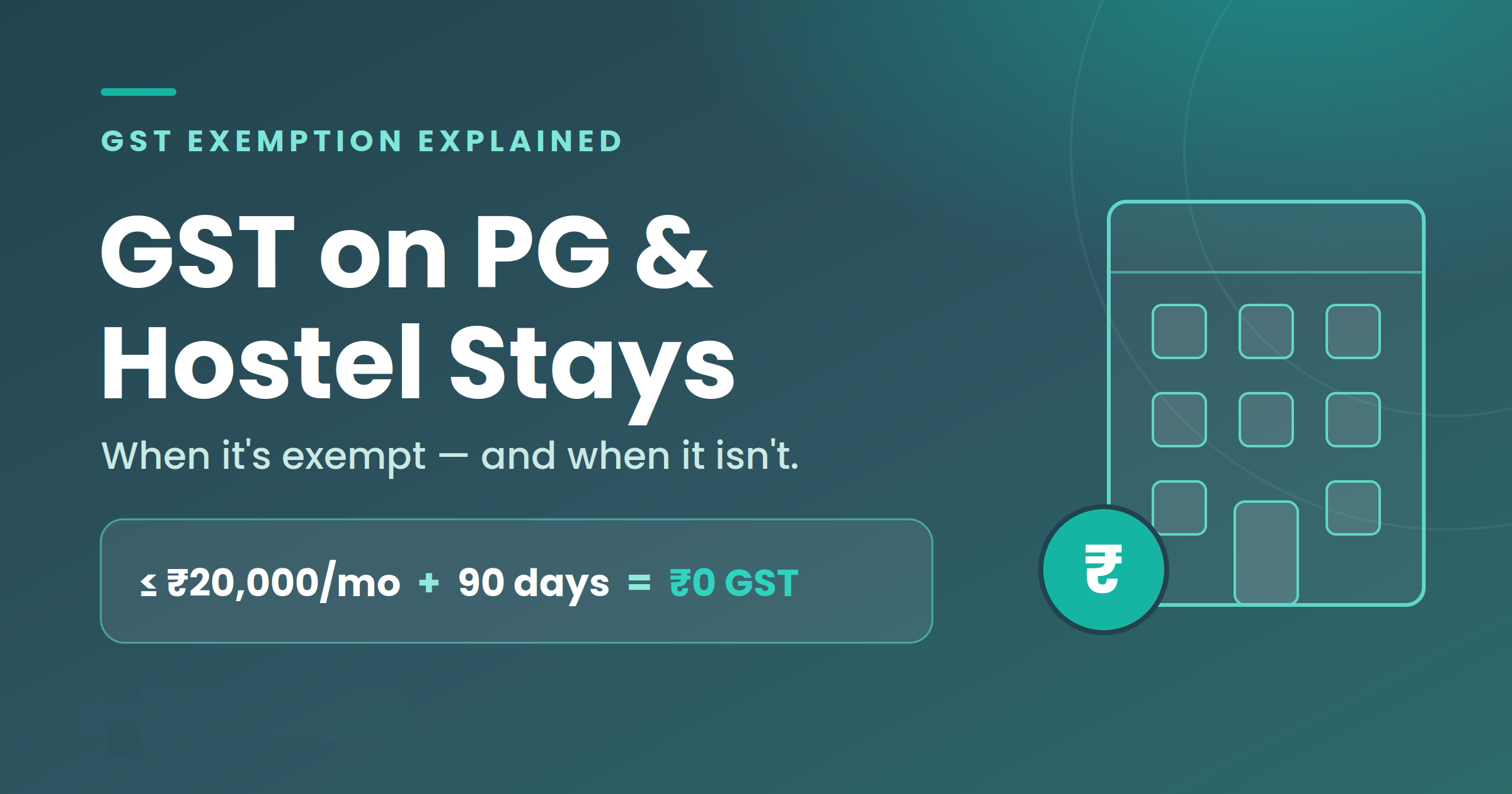
- Exemption from
- 15 July 2024
- Notification
- 04/2024 – Central Tax (Rate)
- Value ceiling
- ₹20,000 / person / month
- Minimum stay
- 90 continuous days
The short version
- Since 15 July 2024, PG and hostel accommodation is exempt from GST when the charge is ₹20,000 or less per person per month and the stay is for a minimum continuous 90 days — both conditions together.
- There is no gender-based difference. Ladies' PGs, men's PGs, girls' and boys' hostels, working women/men hostels and student hostels are all tested by the same two conditions.
- Bundled food and facilities can break the ceiling. If a compulsory all-in package pushes the value over ₹20,000, the exemption can be lost even if the stay is 90+ days.
- If you cross the line, the rate is no longer 12% — since 22 September 2025, non-exempt accommodation up to ₹7,500/day is 5% without ITC.
"Is GST applicable on a ladies' PG?" is one of the most common questions we get from accommodation operators — closely followed by whether men's PGs are treated differently. The short answer to both: the same rule applies, and since July 2024 there's a clear exemption. But the conditions are strict, and the traps are in the detail.
The exemption, in one line
Notification No. 04/2024-Central Tax (Rate), dated 12 July 2024, inserted a new exemption entry into Notification 12/2017-CT(Rate), effective 15 July 2024. CBIC explained the position through Circular No. 228/22/2024-GST. The entry exempts accommodation services on two cumulative conditions:
Meet both, and the accommodation service is exempt. Miss either, and this specific exemption does not apply.
Ladies' PG, men's PG — the law doesn't care
There is no separate exemption for women's hostels and no separate rule for men's PGs. The notification refers generally to a supply of accommodation services meeting the value and duration conditions. So the benefit reaches ladies' PGs, gents' PGs, girls' and boys' hostels, working women and working men hostels, student residences and similar co-living arrangements alike. What matters is the charge, the duration, what's included in the price, and whether the operator also makes taxable supplies — not the gender of the resident.
Quick eligibility check
| Situation | Charge & stay | Position |
|---|---|---|
| Ladies' PG | ₹15,000/mo, 6 months | Exemption may apply |
| Men's PG | ₹18,500/mo, 10 months | Exemption may apply |
| Girls' hostel | ₹20,000/mo, 10 months | Exemption may apply |
| Student hostel | ₹9,000/mo, academic year | Exemption may apply |
| Boys' hostel | ₹12,000/mo, 2 months | Fails — under 90 days |
| Any PG | ₹22,000/mo, 1 year | Fails — over ₹20,000 |
| PG near hospital / exam centre | ₹15,000/mo, 45 days | Fails — under 90 days |
Note the boundary: the notification uses "less than or equal to twenty thousand rupees," so exactly ₹20,000 is within the limit. And the ceiling is tested per person — a room shared by two residents at ₹16,000 each is ₹16,000 per person, not ₹32,000, even though ₹32,000 is collected for the room.
Both conditions must hold — mind the traps
The 90 days must be continuous
The exemption is built for genuine long-stay living, to separate it from hotel-style short lodging. Collecting three months' rent is not the same as establishing a continuous 90-day supply. Where a resident books for six months but leaves after 60, the position needs a proper look at the agreement, the minimum-stay clause, invoices raised and any forfeiture — don't assume that writing "six months" in the form guarantees the exemption in every early-exit case.
Bundled food and facilities can break the ₹20,000 ceiling
Many PGs charge one monthly amount covering room, meals, Wi-Fi, laundry and housekeeping. Where these form one naturally bundled package with accommodation as the principal supply, the composite-supply rules apply and the whole value is tested against ₹20,000 — so a ₹17,000 room plus ₹4,500 of compulsory extras is a ₹21,500 supply that fails the ceiling, even at 90+ days.
Simply splitting a compulsory package into separate invoice lines does not reduce the accommodation value. The treatment can differ only where a service (say, food) is genuinely optional and separately contracted — the actual arrangement matters more than the invoice wording.
Deposits and electricity
A genuinely refundable security deposit is generally not consideration — but if part of it is later adjusted against fees, notice-period charges or damages, that adjustment must be examined. Keep a clear line between a refundable deposit and an advance towards accommodation. Electricity recovered on actual sub-meter consumption should not be assumed automatically in or out of the accommodation value; apply the ₹20,000 test after working out the real value of the accommodation supply.
If you cross the line — the rate changed in 2025
Where a PG fails the exemption (over ₹20,000, or under 90 days), the accommodation becomes taxable. The old 12% figure no longer applies. Since 22 September 2025 (Notification 15/2025-CT(Rate)), the accommodation rate depends on value per unit per day:
Up to ₹7,500 per unit per day
Without ITC — and this is mandatory, with no 18%-with-ITC option. Virtually every PG falls here, since even ₹22,000/month is only about ₹730/day.
Above ₹7,500 per unit per day
With ITC. In practice this affects only premium accommodation — well outside the range of an ordinary PG or hostel.
Registration and input tax credit
Registration and exemption are two different questions. Under Section 23 of the CGST Act, a person supplying only wholly-exempt services isn't liable to register on turnover alone — so a PG making purely qualifying exempt supplies (no taxable extras) may be outside registration entirely, and reverse charge on the landlord's rent also falls away where the operator is unregistered.
The picture changes the moment there are taxable supplies — short-stay residents under 90 days, or other taxable services. Then:
- Aggregate turnover applies. Registration is judged on total turnover (taxable + exempt), against the ₹20 lakh services threshold — not by looking at the taxable slice alone.
- Mixed supplies need care. A PG with both long-stay (exempt) and short-stay (taxable) residents is making a mix — affecting invoicing, collection, returns and ITC.
- ITC follows the supply. Credit attributable to exempt accommodation is restricted; where you have both taxable and exempt supplies, proportionate ITC reversal comes into play.
- Don't collect GST if you shouldn't. An unregistered operator cannot collect "GST," and no one may collect tax on a wholly-exempt supply.
Rent paid to the building owner is a separate supply
The rent the operator pays the property owner and the accommodation the operator gives residents are two different transactions. The fact that the accommodation to residents is exempt does not automatically make the landlord's rent exempt — that turns on the parties' status, registration, the nature of the property and any reverse-charge provisions.
What about the period before 15 July 2024?
There's relief here too. Per Circular 228/22/2024-GST, GST liability for qualifying accommodation was regularised on an "as is where is" basis for 1 July 2017 to 14 July 2024, where the value was ₹20,000 or less per person per month and the stay was at least 90 continuous days. From 15 July 2024, the statutory exemption takes over.
Operator's compliance checklist
- Document the stay. Resident details, joining date, expected and actual duration, and an agreement or admission form that establishes continuity.
- Separate the money. Accommodation value, food and facility charges, and whether extras are compulsory or optional — plus a clean line between deposits and advances.
- Track exempt vs taxable turnover separately, and review registration whenever taxable supplies enter the mix.
- Issue correct invoices/receipts and, where ITC is involved, keep the working for any proportionate reversal.
Run a PG, hostel or co-living space?
efiletax can review your pricing, agreements and turnover, confirm whether you need to register or charge GST, and keep your invoicing and returns clean.
Talk to our GST teamDisclaimer: This article is general information reflecting the GST provisions and official guidance reviewed as at the date of publication. It is not legal or tax advice. GST treatment depends on the actual contractual terms, nature of supplies, registration status and individual facts. Please obtain professional advice — talk to efiletax — before taking a tax position.