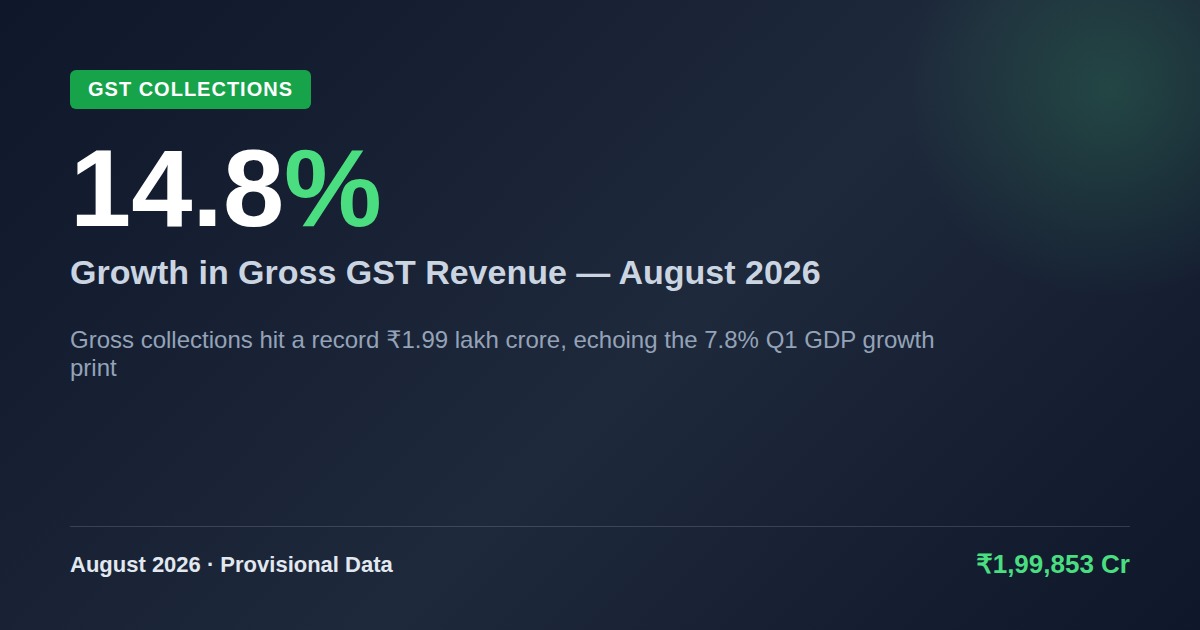
Quick take: GST collections had a strong August — up nearly 15% from a year ago — and the timing lines up nicely with two other pieces of news doing the rounds this week: a solid GDP print and a rupee that's been sliding against the dollar. Here's the full picture, numbers included.
GST Collections Jump 14.8% to ₹1.99 Lakh Crore in August 2026
India's gross GST revenue rose 14.8% year-on-year to ₹1,99,853 crore in August 2026, according to provisional data released by the government on September 1. This is one of the stronger monthly readings of the year, and it comes on the back of both healthy domestic consumption and a sharp jump in import-related tax collections.
Net GST revenue — the number left after refunds are paid out — grew a more modest 8.3% to ₹1,68,057 crore, up from ₹1,55,181 crore in August last year. The gap between the gross and net growth rates is explained almost entirely by a surge in refunds, which we'll get to below.
Where the Growth Actually Came From
Break the number down and two engines were running here. Gross domestic transactions grew a healthy 9.3% to ₹1,37,249 crore (from ₹1,25,570 crore), which reflects steady on-ground consumption and business activity within the country. But the standout was imports, where GST revenue jumped 29% to ₹62,604 crore from ₹48,546 crore a year earlier — imports growing roughly three times as fast as domestic transactions.
That import surge is worth sitting with for a second, because a weaker rupee makes every imported dollar's worth of goods cost more in rupee terms — and GST on imports is charged on that rupee value. We'll connect this dot properly in the currency section below.
| Head | Aug 2025 | Aug 2026 | Growth |
|---|---|---|---|
| CGST | ₹34,076 Cr | ₹38,413 Cr | +12.7% |
| SGST | ₹42,854 Cr | ₹46,316 Cr | +8.1% |
| IGST (Domestic) | ₹48,639 Cr | ₹52,520 Cr | +8.0% |
| IGST (Imports) | ₹48,546 Cr | ₹62,604 Cr | +29.0% |
| Total Gross GST | ₹1,74,116 Cr | ₹1,99,853 Cr | +14.8% |
The Refund Story: Why Net Growth Trails Gross Growth
Refunds jumped 67.9% year-on-year to ₹31,795 crore. Domestic refunds rose 72.6% to ₹18,490 crore, while export refunds processed through ICEGATE climbed 61.8% to ₹13,305 crore. Faster refund processing is generally good news for businesses — it means working capital gets released back to them sooner — but it's also the reason net revenue growth (8.3%) looks noticeably softer than gross growth (14.8%). After accounting for refunds, net domestic revenue grew just 3.4% to ₹1,18,759 crore, while net customs revenue rose a strong 22.3% to ₹49,299 crore.
State-Wise: Who's Leading, Who's Lagging
Domestic GST collections (which exclude import GST) grew 9% nationally in August. A few states stood out on either side:
| State/UT | Aug 2026 | YoY Growth |
|---|---|---|
| Assam | ₹3,679 Cr | +162% |
| Uttar Pradesh | ₹9,092 Cr | +19% |
| Gujarat | ₹12,047 Cr | +15% |
| Telangana | ₹5,343 Cr | +16% |
| Maharashtra | ₹28,779 Cr | +8% |
| Himachal Pradesh | ₹668 Cr | -23% |
| Sikkim | ₹170 Cr | -63% |
| Meghalaya | ₹163 Cr | -21% |
Assam's 162% jump is the eye-catcher of the table, though on a relatively small base — worth watching whether it holds up in coming months rather than reading too much into a single data point.
"A strong 14.8% growth in overall GST collections have added to the cheer of 7.8% growth in GDP in Q1. This collectively shows the robustness of the Indian economy despite geo-political conflicts and global economic uncertainty."
— Abhishek Jain, Partner and National Head, Indirect Tax, KPMG in India
So, Does This Connect to the 7.8% GDP Number?
Yes, and it's a fairly natural pairing. India's real GDP growth for Q1 FY27 (April–June 2026) came in at 7.8%, and GST is essentially a running scoreboard of economic activity — every rupee of consumption, manufacturing, and trade eventually shows up here as tax. A GDP print measures the size of the pie over a quarter; GST collections are the government's near-real-time cash register reading on the same underlying activity, just one month later and updated monthly instead of quarterly.
Read together, they tell a consistent story: GDP for April–June says the economy grew fast, and GST for August says that momentum didn't fade going into the new quarter — domestic collections were still up 9.3%, not just holding steady but accelerating on a broader base. That's exactly the kind of corroboration economists like to see, because GDP numbers get revised later while GST collections are actual cash flowing in, which makes them a nice reality check on the GDP story.
One caution worth flagging as a fellow reader of these reports: correlation isn't causation, and one strong month doesn't confirm a trend on its own. The bigger tell will be whether September and October collections (which will reflect early festive-season demand) keep pace.
The Rupee Angle: Why a Weaker INR Shows Up in This Data Too
Here's the part that doesn't always get discussed in the headline coverage. Over the last three months, the USD-INR rate has ranged between ₹94.26 and ₹96.79, averaging around ₹95.43 — a rupee that's been under sustained pressure. That matters directly for the import-GST number, because GST on imported goods is levied on their assessed value converted into rupees. When the rupee weakens, the same shipment of, say, crude oil or electronics components priced in dollars translates into a bigger rupee figure at customs — and a bigger rupee figure means more GST collected on it, even if the physical quantity imported hasn't changed at all.
That's a plausible partial explanation for why import GST revenue (+29%) grew more than three times as fast as domestic GST revenue (+9.3%) this month. Some of that 29% is genuinely higher import volumes — India's imports do tend to rise with a growing economy — but some of it is simply the currency-translation effect of a weaker rupee inflating the rupee value of the same imported goods. Without a volume/price breakdown from customs data, it's hard to split the two precisely, but it's a reasonable hypothesis and one worth keeping in mind rather than crediting the entire import surge to "growth."
It's a useful reminder that not every good economic headline is purely "more real activity" — sometimes a chunk of it is exchange-rate arithmetic. Neither reading cancels the other out; they just tell you to hold the number with a little more nuance than the top-line percentage suggests.
What's Next: GST Council Meeting on September 12
The GST Council's 57th meeting is scheduled for September 12 in New Delhi, with an officers' preparatory meeting the day before on September 11. Council meetings are where rate rationalisation, compliance changes, and sector-specific relief measures typically get decided, so it's worth keeping an eye on for anyone tracking tax policy — we'll cover the outcomes here once they're announced.
The Bottom Line
August was a genuinely strong month for GST collections, powered by both steady domestic demand and an import surge that's likely part real growth, part rupee weakness. Paired with a healthy 7.8% GDP print for the June quarter, the broader picture looks encouraging — though as always with economic data, one good month (or quarter) is a data point, not a guarantee. The next few readings, especially through the festive season, will tell us whether this is a genuine trend or a comfortable coincidence of good timing.
Source: Times of India, GST Council Secretariat provisional data (as on 31/8/2026). Figures are provisional and may vary slightly on finalisation.