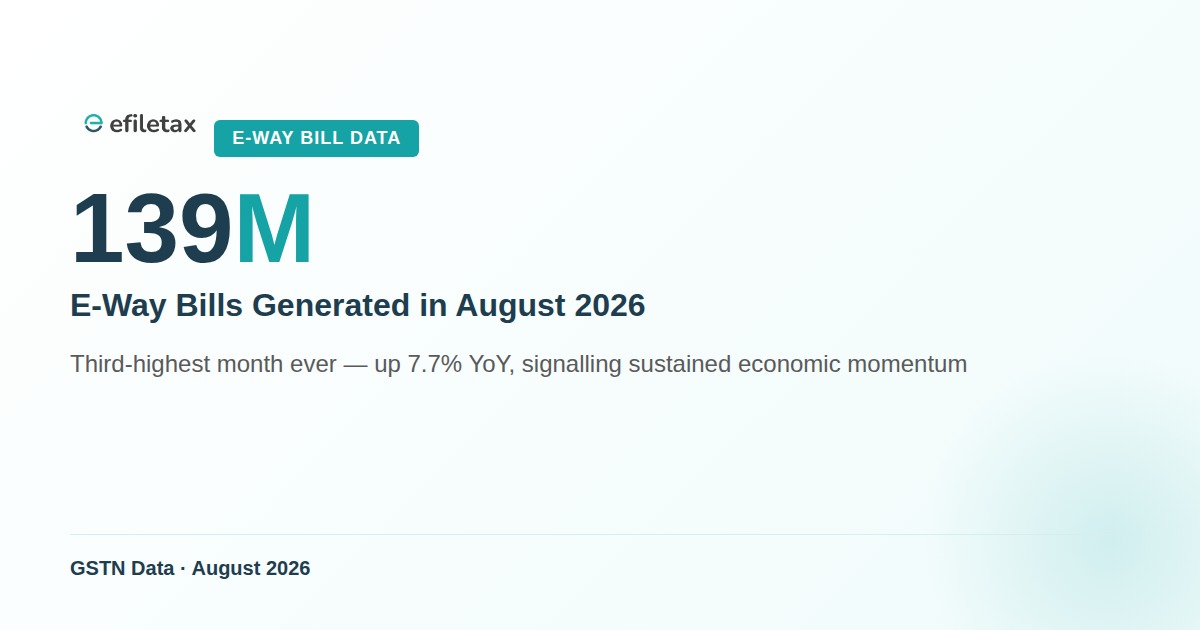
E-way bill generation crossed 139 million in August — the third-highest monthly count on record. That's a good proxy for how much stuff is actually moving around the country, and it's flashing a fairly upbeat signal heading into the festive season.
E-Way Bills Cross 139 Million in August, Signalling Sustained Economic Momentum
E-way bill generation rose 7.7% year-on-year to 139.08 million in August 2026 — the third-highest monthly count ever recorded. An e-way bill is the electronic document required under GST for moving goods worth more than ₹50,000 (subject to specified conditions and exceptions), so this number is essentially a live pulse-check on how much freight is actually crossing the country.
Put in context: the August count was 99.5 lakh higher than August 2025's 129.13 million. Sequentially it dipped a marginal 0.51% from July's 139.79 million (the second-highest month ever) — but only March (140.60 million) and July have ever scored higher. So August isn't a peak, it's a very strong "new normal" reading, sitting comfortably near the top of the all-time range.
Why This Number Matters
E-way bill counts are considered one of the more reliable real-time indicators of economic activity, consumption, and inter-state trade — arguably faster-moving than GDP and less noisy than GST collections alone (since GST revenue also swings with tax rates, refunds, and import prices, as we discussed with the August GST numbers). A higher e-way bill count generally means more goods are physically moving, which usually means more businesses are transacting formally rather than staying under the radar.
"The consistent upward trend is a strong signal of underlying economic resilience, driven by improved compliance, formalisation of business activity, and steady consumption demand across sectors."
— Saurabh Agarwal, Tax Partner, EY India
Agarwal also flagged the road ahead: with the festive season starting, GST collections could get an extra lift. "Building on this positive trajectory, it is reasonable to expect that collections in September are likely to be even more robust, as the country moves into the festive season."
"With March and July also posting record highs, this trend suggests consumption and inter-state trade remaining resilient, which is likely to translate into strong GST collection numbers in the coming months."
— Harpreet Singh, Partner, Deloitte
How Goods Are Actually Moving
A quick look under the hood of how these e-way bills get generated and transported tells its own story about India's logistics backbone:
| Mode of Generation | Share |
|---|---|
| Mobile / SMS / API | 78.47% |
| Website | 17.06% |
| Excel Tool | 3.78% |
| Mode of Transport | Share |
|---|---|
| Road | 98.73% |
| Air | 0.65% |
| Rail | 0.56% |
| Ship | 0.06% |
Two takeaways here: over three-quarters of e-way bills are now generated through mobile, SMS, or API rather than the website — a sign of how deeply integrated GST compliance has become with everyday billing software. And road transport still dominates goods movement almost completely, which is worth keeping in mind whenever fuel prices or highway logistics come up in the same breath as GST numbers.
The Bigger Trend: Steady Growth, Not a One-Off Spike
Zooming out, e-way bill generation has been on a fairly steady march upward. Monthly totals moved from roughly 11.9 crore in June 2025 to a run of 13–14 crore months through late 2025 and into 2026, with March 2026 setting the current all-time high at 14.06 crore. Intra-state movement consistently makes up about two-thirds of all e-way bills, with inter-state trade filling the rest — a ratio that's held steady for over a year now, suggesting no major structural shift in how goods are flowing across versus within states.
The user base tells a similar growth story: registrations on the e-way bill portal have grown from about 38.5 lakh in January 2021 to 73.8 lakh by June 2026 — essentially doubling in five and a half years — while transporter and unregistered-person enrolments have climbed from roughly 55,800 to just under 97,000 over the same period. More registered users generating more bills each month is exactly the kind of formalisation trend Agarwal referred to.
Connecting the Dots with Consumption Data
This lines up with official data released last week showing private final consumption expenditure grew 7.1% in Q1 FY27 (April–June 2026) — a strong showing that supports the broader picture of resilient domestic demand. Consumption, GDP, GST collections, and e-way bill generation are really four different lenses on the same underlying economy, and right now most of them are pointing the same direction: activity holding up well, even if the pace of e-way bill growth itself has cooled somewhat compared to last year.
That cooling is worth a small caveat: 7.7% YoY growth is solid, but it's not accelerating the way it was in earlier months of this cycle. It's less "the economy is speeding up" and more "the economy is holding a fast pace steadily" — which, going into a festive quarter, is arguably the more reassuring signal of the two, since festive demand tends to add its own seasonal bump on top.
The Bottom Line
139 million e-way bills in a single month is a big number by any measure, and the fact that it's the third-highest ever — trailing only March and July of this year — says goods movement in India is running at a sustained high, not a temporary blip. Combined with the 7.1% consumption growth and the GST collection trends we've covered separately, the festive season is shaping up to be one worth watching for tax and trade data alike. As always, one month's numbers are a data point, and the real test will be whether September and October keep this momentum going.
Source: GST Network (GSTN) e-way bill statistics, as on 7 July 2026 / August 2026 provisional figures; expert commentary from EY India and Deloitte.