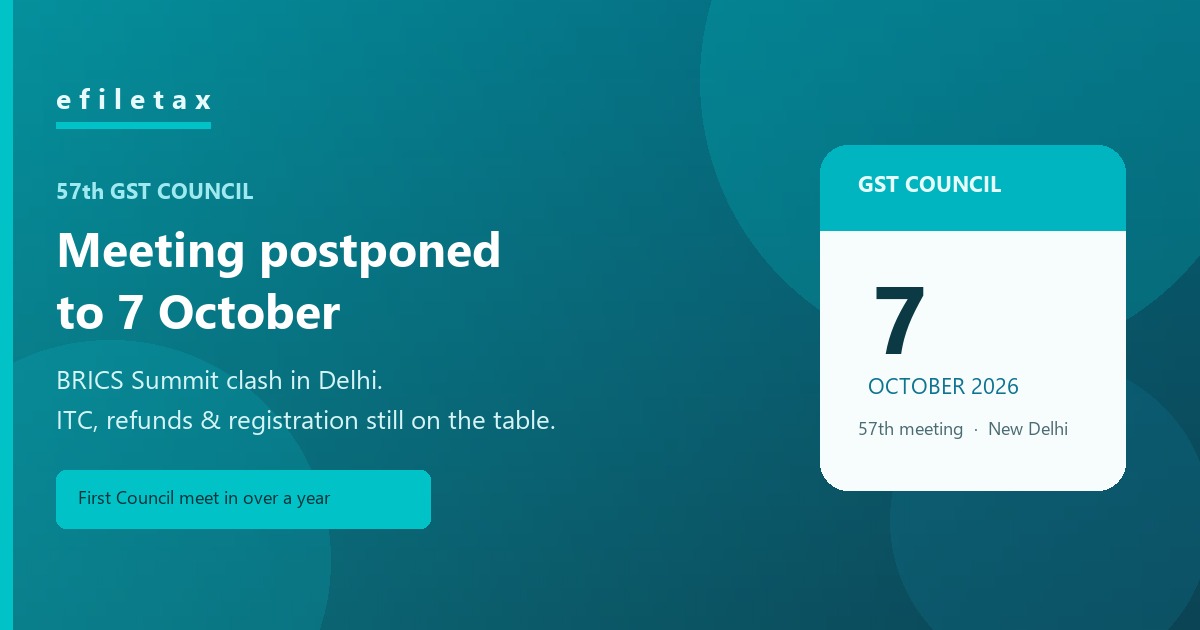
The 57th meeting of the GST Council, earlier fixed for 12 September 2026, has been moved to 7 October 2026 in New Delhi. Multiple government sources have linked the shift to the 18th BRICS Leaders’ Summit in Delhi on 12–13 September. An official notification confirming the new date had not been issued as of 6–7 September 2026. Treat 7 October as likely, not locked, until the GST Council Secretariat notifies it.
This will be the first Council meeting in more than a year. The 56th meeting on 3–4 September 2025 approved the GST 2.0 rate overhaul. Most goods and services moved to 5% or 18%, with a 40% rate for a limited set of demerit and luxury items. Those rates took effect from 22 September 2025. October is not another rate reset. The unfinished work is credit, refunds, registration and litigation.
Quick facts
- Council meeting: 7 October 2026, New Delhi (sources; notification pending)
- Officers’ meetings: 5 October, 3 pm and 6 October, 11 am
- Last Council meet: 56th meeting, 3–4 September 2025
- GST 2.0 rates: 5% / 18% / 40%, effective 22 September 2025
Why September 12 did not work
India is hosting the BRICS Summit at Bharat Mandapam on 12–13 September. Delhi has already planned large security and traffic arrangements around those dates, including a holiday for Delhi government offices on 11 September. Holding a full Centre–State tax meeting in the capital on the opening day of the summit was a logistics problem, not a policy pause.
The GST Council is chaired by the Union Finance Minister and includes State and Union Territory finance ministers. Under the GST Council Rules, it is expected to meet at least once a quarter. A gap of more than a year after a major rate change is long. States that want to raise revenue or inverted-duty issues will have waited an extra month. Businesses waiting on ITC and refund design will wait with them.
What is likely on the table
The agenda is still being finalised. Reports from Business Standard, Mint, Hindu Business Line, Financial Express and Moneycontrol point to the same cluster of items. None of this is law until the Council recommends it and the Centre notifies it.
1. Buyer ITC when the supplier does not deposit tax
Section 16(2)(c) of the CGST Act still ties the recipient’s credit to the supplier actually paying the tax to the government. A bona fide buyer who has a tax invoice, has received the goods or services, and has paid through banking channels can still lose ITC if the supplier defaults.
One proposal under discussion would protect such buyers if they can show payment of the invoice, including GST, through banking channels or other prescribed documents. That is a policy choice the Council has to make. Courts have already been pulled into the same fight. efiletax has separately covered the Supreme Court’s stay of the Tripura High Court ruling that had read down Section 16(2)(c). Until Parliament or the Council changes the statute, field officers will keep using supplier default to deny credit. Do not assume October will fix every live SCN.
2. Blocked credit under Section 17(5)
Industry has asked the Council to ease blocked credits on motor vehicles used for employees, group health and life insurance, food and beverages, outdoor catering, and construction of immovable property (the Safari Retreats line of disputes). If the Council recommends any of this, it will need a law or notification change. Until then, the existing blocks stay.
A related ask is to let accumulated ITC be used against reverse-charge liability. That is not how the portal works today. Flag it as a representation item, not as a current right.
3. Inverted duty refunds, including input services
The refund formula for inverted duty still leaves many manufacturers and traders with stuck credit on input services. Tax professionals have asked the Council to bring input services into the inverted-duty refund calculation. Moneycontrol had also reported a proposal to automate 90% of low-risk ITC refunds on a risk-score basis, instead of waiting for an officer to clear each claim. Average processing is still reported around 50 days. If that automation is approved, working capital improves. If it is deferred, cash stays stuck.
4. Registration for large credit passers
Rule 14A already gives a faster track to low-risk / small applicants. Hindu Business Line reports that about 65% of new registrations now go through that route. The remaining 35% — typically businesses that pass on ITC of more than ₹2.5 lakh a month — still face uneven document lists between Centre and State formations. CBIC has spoken of a uniform circular. The Council may settle that circular and cancellation norms. PAN-India groups should watch this more than any rate rumour.
5. Compensation cess credit left in the ledger
GST 2.0 ended compensation cess on most goods from 22 September 2025 and folded the burden into GST, including the 40% slab. Auto dealers have said unutilised cess credit of around ₹2,500 crore is sitting in electronic credit ledgers, and FADA has gone to the Supreme Court. Cross-utilisation of cess credit into CGST/SGST/IGST is restricted. This is a live dispute. Do not write off or utilise that balance on the strength of a news report.
What this is not
This is not GST 3.0. Rate slabs are not the story of this meeting. Mint has reported that the Council may review whether 2025 rate cuts actually reached retail prices, and may look again at 18% GST on mobile phones. Treat those as possible discussion points. Do not reprice inventory on a leak.
Some circulating notes name new finance ministers for West Bengal, Tamil Nadu and Kerala as attending on 7 October. Those names have not been corroborated in the national reports we used for this piece. Membership of the Council follows whoever holds the State finance portfolio on the date of the meeting. It does not change the legal agenda.
What businesses should do before 7 October
- Reconcile GSTR-2B vs books now. Supplier-default ITC disputes will not wait for a Council decision. If a vendor’s tax is unpaid, document your invoice, e-way bill, bank proof and follow-up. That file is what you will need, with or without a safe-harbour.
- Map inverted-duty and blocked-credit exposure. List accumulated ITC that cannot be used, Section 17(5) blocks, and RCM paid in cash. That is the briefing note your CFO should have if the Council actually moves.
- Do not change GSTIN / pricing / cess ledgers on rumours. Wait for the press release, then the notification, then the portal advisory.
- Large B2B registrants: keep KYC and place-of-business papers ready. A uniform registration circular, if issued, will still ask for documents. Missing papers delay GSTIN more than the circular itself.
efiletax view
October 7 is useful only if it produces notifications, not speeches. The rate work was done in September 2025. The credit and refund design is what still hits working capital. We will update this note when the official agenda and, later, the recommendations are out. Until then, file on the law as it stands.
FAQs
Has the 7 October date been officially notified?
Not as of 6–7 September 2026. Business Standard, Mint and others reported the date from government sources. An office memorandum to members has reportedly shifted officers’ meetings to 5 and 6 October. Watch gstcouncil.gov.in for the notice.
Will GST rates change again on 7 October?
Unlikely as a second overhaul. The 56th meeting already collapsed the old 5/12/18/28 structure. Any item-wise review (for example mobiles) would be a separate recommendation, not a new slab system.
If the Council protects bona fide buyers, can I claim old denied ITC?
Only if the recommendation is notified with a clear start date, and only for the periods it covers. Past SCNs under Section 16(2)(c) will not vanish automatically.
Does a Council recommendation apply the next day?
No. Recommendations need Central and State notifications, and often a portal change. efiletax will track the gazette, not the press conference.
Need help before the meeting? If you have stuck inverted-duty refunds, supplier-default ITC notices, or a multi-State registration pending, speak to efiletax. We will map the exposure against the current law, not against rumours.
Sources: Business Standard (6 Sep 2026); Mint (6 Sep 2026); The Hindu Business Line (6 Sep 2026); Financial Express (6 Sep 2026); Moneycontrol (1 Sep 2026); Economic Times / PTI (6 Sep 2026). Agenda items remain unconfirmed until the Council Secretariat circulates the note.